
Our Team
Dr. Mirajul H. Kazi, Ph.D.,
MS(University of Maryland)
(Principal Founder)

Dr. Mirajul H. Kazi, popularly known as “Kazi”, is a translational research scientist specializing in cell and molecular physiology, focusing on gastrointestinal, renal, respiratory, diseases. His work is recognized for elucidating how dysregulation in epithelial transport proteins contributes to systemic diseases (hyperuricemia, metabolic, sterile inflammation). Dr. Kazi’s multidisciplinary research spans gene discovery, animal models, and clinical-translational studies, contributing significantly to the understanding of epithelial linked disease and its progression. Most notably, Dr. Kazi is recognized as the first scientist to elucidate how genetic defects in intestinal urate transport can lead to chronic hyperuricemia, ultimately resulting in metabolic diseases. This groundbreaking discovery provides valuable insights into the genetic and physiological mechanisms underlying these complex conditions
Currently, Dr. Kazi is an Associate Scientist at Catalent Pharma, where he is interested and applies his expertise to optimize and accelerate various analytical methods to fit for purpose for the cell & gene therapy(CGT) industry. His career reflects a deep commitment to advancing biomedical science and translating discovery into therapeutic innovation.
Education
Dr. Kazi earned his Ph.D. in Physiology from Jadavpur University, sponsored by the Indian Council of Medical Research, and holds an M.S. in Regulatory Science (Pharmaceutical) from the University of Maryland School of Pharmacy, Baltimore, USA. He completed postdoctoral training at both Yale University School of Medicine and Johns Hopkins University School of Medicine, USA.
Dr. Kazi has authored multiple peer-reviewed publications as first and corresponding author in high-impact journals, including Nature Communications, and has received various national and international awards for his scientific contributions. His editorial and peer-review roles include serving on the editorial board of Physiological Reports, as a Review Editor in Gastrointestinal Sciences for Frontiers in Physiology, and as an invited reviewer for several leading journals.
Dr. Kazi is also a committed mentor, having successfully guided four Ph.D. students during his tenure as a Principal Investigator at the National Institute of Cholera & Enteric Diseases in Kolkata, India.

Three most influential and insightful publications
1. Hoque KM, Eryn E Dixon, Raychel M. Lewis, Jordyn Allan, Gregory D. Gamble, Amanda Phipps-Green, Victoria L. Halprin-Kuhns, Anne Horne, Lisa K. Stamp, Tony R. Merriman, Nicola Dalbeth, Owen M. Woodward. The ABCG2 Q141K hyperuricemia and gout associated variant illuminates the physiology of human urate excretion. 2020; Nat Commun. 11(1):2767. [ https://pubmed.ncbi.nlm.nih.gov/32488095/ ]
2. Hoque, K. M, Rajendran, V.M., Binder, H. J.(2005). Zinc inhibits cAMP-stimulated Cl secretion via basolateral K channel blockade in rat ileum. Am J. Physiol-Gastrointest Liver Physiol 288: G956-G963.[ https://pubmed.ncbi.nlm.nih.gov/15618279/ ]
3. Aoun, J; Mikio Hayashi, Sheikh IA, Sarkar P, Tultul Saha, Tanya Chatterjee, Pinak Chakrabarti, Manoj K Chakrabarti and Hoque KM* Anoctamin 6 Contributes to Cl- Secretion in Accessory Cholera Enterotoxin (ACE) Stimulated Diarrhea: An Essential Role for Phosphatidylinositol 4, 5-biphosphate (PIP2) signaling in cholera (2016); J Biol Chem. 291(52):26816 – 26836. [ https://pubmed.ncbi.nlm.nih.gov/27799301/ ]
Full Biography:
https://www.ncbi.nlm.nih.gov/myncbi/16KIhylX5de95D/bibliography/public/
Notable therapeutic value from the research work
1. An analog of cucurbitacin identified in cucumber may treat intestinal motility disorder and cystic fibrosis.
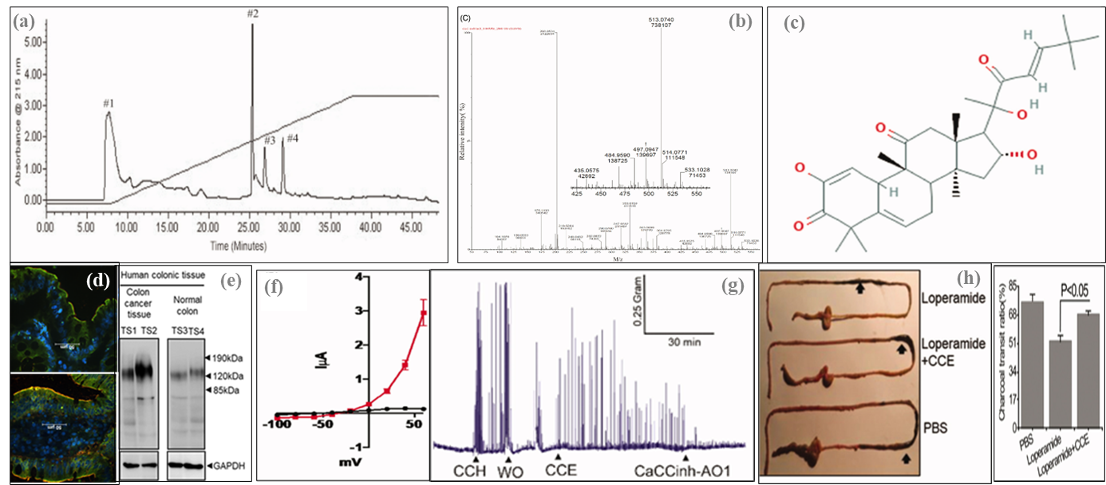
Demonstration of (a) preparative HPLC chromatogram showing bio-active fraction (#2) from cucumber extract (CE). (b) High resolution mass spectral scan of the purified fraction (HPLC fraction #2) revealed a CCB-like entity with a prominent protonated molecular ion at m/z 513.0740. (c) Suggested 2 D structure for the bioactive CCB-like compound corresponding to the elemental formula C31H44O6 (PubChem CID 58599137). (d) Expression of ANO1 at the brush-border membrane of the human intestine (green) and colocalize with villin, a brush-border membrane marker (red) identified by confocal microscopy. (e) Anti-ANO1 antibody recognizes a protein of appropriate size in human colonic cancer tissue, (f) CE activates the well-characterized endogenous TMEM16A(ANO1)-induced Cl– current in Xenopus laevis oocytes. (g) Representative traces showing the effect of the purified molecule on smooth muscle contraction in isolated mouse colon and its inhibition by CaCCinh-A01, a finding indicates that purified CE may offer a beneficial role in augmenting spontaneous motility and contractility by activating ANO1 channels. (h) (g) Representative image of isolated mouse intestinal tracts showing the movement of activated charcoal after oral gavage of PBS (positive control), and Loperamide in the presence or absence of active molecules. Bar graph showing a summary of the % charcoal transit ratio under the three conditions tested.
Published in Pharmaceutical Biology(i) at https://pmc.ncbi.nlm.nih.gov/articles/PMC8354179/

Saijuddin Shaikh
Dr. Saijuddin Shaikh is a Public Health Nutrition specialist with more than 25 years of leadership experience in nutrition research, community-based health interventions, and evidence-informed policy development. Dr. Shaikh’s work focuses on improving maternal and child nutrition, addressing macro- and micronutrient deficiencies, and tackling the rising burden of diet-related non-communicable diseases. His expertise encompasses nutrition epidemiology, body composition assessment, community-based survey design, randomized controlled trials (RCTs), and advanced statistical analysis. He has contributed to major research initiatives, program evaluations, and training programs aimed at strengthening nutrition service delivery across diverse populations. His international experience includes work in the USA, Thailand, Bangladesh, and India.
Education
Dr. Shaikh holds a master’s degree in Physiology and a Ph.D. in Nutrition from the University of Calcutta, India. Later Dr. Sheikh completed his Master of Public Health (MPH) from Mahidol University, Thailand. With more than 100 peer-reviewed publications and a book chapter, Dr. Shaikh is widely recognized for his ability to translate complex scientific evidence into practical, actionable recommendations for policymakers, healthcare professionals, and community stakeholders. His continued commitment to public health contributes to shaping effective nutrition strategies and evidence-based interventions globally.
Other areas of Expertise
- Data collection tool development
- Implementation and management of community-based cluster and individual RCTs
- Development of age, sex, and ethnicity-specific body composition equations using deuterium dilution, DXA, BIA, and anthropometry
- Project proposal development
- Data analysis and scientific writing
- Systematic reviews and meta-analyses
- Cochrane review preparation
Dr. Mondal, is a translational neuroscientist specializing in cellular and molecular neurobiology, focusing on molecular mechanisms and novel therapeutic intervention against Alzheimer’s disease (AD), Parkinson’s, disease (PD), and depression. His work is recognized for elucidating how polyphenols, small molecules alleviate the progress of AD, PD severity and its hallmarks deploying pre-clinical model systems. Dr. Mondal’s multidisciplinary research spans animal models, and clinical-translational studies, contributing significantly to the understanding the diseases and its progression.
Currently, Dr. Mondal is a tenure track Professor of Cellular & Molecular Neurobiology at Jawaharlal Nehru University, New Delhi, (Rank-1 public university in India), where he is interested and applies his expertise to screen therapeutic potential of polyphenols, small molecules to optimize and accelerate various analytical methods to develop novel drugs. His career reflects a deep commitment to advancing biomedical science and translating discovery into therapeutic innovation.

Dr. Amal C. Mondal, Ph.D. (Jadavpur University, Kolkata)
Education
Dr. Mondal earned his Ph.D. in Science from Jadavpur University, sponsored by Chittaranjan National Cancer Institute (CNCI), Kolkata. He completed postdoctoral training at University of Illinois at Chicago (UIC), Chicago, USA. Dr. Mondal has authored multiple peer-reviewed publications as first and corresponding author in high-impact journals, including Chemical Science, Apoptosis, Neuropharmacology, Molecular Neurobiology, Journal of Pharmaceutical Analysis and has received various national and international awards / accolades for his scientific contributions. He is elected fellow of International Union of Physiological Sciences (IUPS) and Royal Society of Biology (RSB), West Bengal Academy of Science & Technology (WBAST) and NESA Eminent Scientist of the year-2022. His editorial and peer-review roles include serving on the editorial board of Frontiers in Endocrinology, and earlier served as Associate editor of Journal of Alzheimer’s disease, Brain Sciences, and invited reviewer for several leading journals. Dr. Mondal is also a committed mentor, having successfully guided twelve Ph.D. students during his tenure as an Asstt. Professor at Raja Peary Mohan College, Uttarpara, Hooghly, West Bengal and as Professor at Jawaharlal Nehru University in New Delhi, India.
Four most influential and insightful publications
1. Sahu MR, Ahmad MH, & Mondal AC*. MST1 selective inhibitor Xmu-mp-1 ameliorates neuropathological changes in a rat model of sporadic Alzheimer’s disease by modulating Hippo-Wnt signaling crosstalk. Apoptosis 2024 Oct; 29 (9-10): 1824-1851.doi:10.1007/s10495-024-01975-0. Epub 2024 May 17. https://pubmed.ncbi.nlm.nih.gov/38760516/
2. Rani L, Ghosh B, Ahmad MH, & Mondal AC*. Evaluation of Potential Neuroprotective Effects of Vanillin against MPP+/MPTP-Induced Dysregulation of Dopaminergic Regulatory Mechanisms in SH-SY5Y cells and a Mouse Model of Parkinson’s disease. Molecular Neurobiology 2023 Aug; 60(8):4693-4715. doi: 10.1007/s12035-023-03358-z. Epub 2023 May 5. https://pubmed.ncbi.nlm.nih.gov/37145378/
3. Ahmad MH, Fatima M, Ali M, Rizvi MA, & Mondal AC*. Naringenin alleviates paraquat-induced dopaminergic neuronal loss in SH-SY5Y cells and a rat model of Parkinson’s disease. Neuropharmacology, 2021 Dec 15; 201: 108831. doi: 10.1016/j.neuropharm. 2021.108831. https://pubmed.ncbi.nlm.nih.gov/34655599/
4. Paul A, Kumar S, Kalita S, Kalita S, Sarkar D, Bhunia A, Bandyopadhyay A, Mondal AC*, Mondal B. An explicitly designed paratope of amyloid-β prevents neuronal apoptosis in vitro and hippocampal damage in rat brain. Chemical Science, 2020, 12 (8):2853-2862. Edge Article. [Epub 2020, 22 Dec]. https://pubmed.ncbi.nlm.nih.gov/34164050/
5. Ahmad MH, Fatima M, Hossain M, Mondal AC*. Evaluation of naproxen-induced oxidative stress, hepatotoxicity and in-vivo genotoxicity in male Wistar rats. Journal of Pharmaceutical Analysis, 2018 Dec; 8(6):400-406. https://pubmed.ncbi.nlm.nih.gov/30595947/